
01May 24
The Perils of Bias in Workplace GenAI
In the rapidly evolving landscape of tech, Generative Artificial Intelligence (GenAI) is becoming a central player, especially in sectors like customer service, content creation, and…


 Merry Christmas! Wait. What? Can we still say that in public? Why yes, we can, but not at the cost of excluding all other religions in the workplace.
For those that do not celebrate Christian holidays (and/or secular commercial holidays derived from Christian traditions), focusing only on Christian traditions can feel like exclusion.
It’s hard to feel like you belong if you don’t share similar traditions. Taken too far, and the exclusion can evolve into religious discrimination, giving rise to religious accommodation obligations.
Religious accommodation can be tricky, particularly where an employer may not be aware of the religious practices of the religion practiced by an employee. For example, if one of my employees came to me, told me they practiced the religion Klingon and required certain days off would I have to let them? What makes a religion a religion such that an employer must accommodate an employee’s religious practices?
Creed Under the Human Rights Code
The Ontario Human Rights Code prohibits discrimination or adverse treatment with respect to religion or “creed.” This could look like refusing to make an exception to dress code requirements or refusing to recognize religious dress requirements, refusing to allow employees to observe periods of prayer at particular times of the day or refusing to allow employees time off to observe religious holidays.
So back to my Klingon question, do I have to allow my Star Trek worshiping employee the day off or face a religious discrimination complaint?
What Constitutes a Religion?
According to the Ontario Human Rights Commission a religion “includes the practices, beliefs and observances that are part of a faith or religion” and “[i]t does not include personal moral, ethical or political views.” The Code also does not provide protection for beliefs “that promote violence or hate towards others, or that violate criminal law.”
Creed in the Case Law
Atheism ✔
In R.C. (Next friend of) v. District School Board of Niagara, the Ontario Human Rights Tribunal determined that atheism is a creed deserving of protection under the Code. The Tribunal looked at the Supreme Court’s comments, and definition of religion under s.2(a) of the Canadian Charter of Rights and Freedoms, in Syndicat Northwest v. Amselem. In Syndicat the Court stated that:
“In essence, religion is about freely and deeply held personal convictions or beliefs connected to an individual’s spiritual faith and integrally linked to one’s self-definition and spiritual fulfilment, the practices of which allow the individuals to foster a connection with the divine or with the subject or object of that spiritual faith.”
While atheism refutes, as opposed to fosters, a connection with the divine, the Tribunal also considered international human rights law, particularly Article 18(1) of the International Covenant on Civil and Political Rights, to which Canada is a ratifying party.
Section 18(1) of the International Covenant on Civil and Political Rights reads:
“Everyone shall have the right to freedom of thought, conscience and religion. This right shall include freedom to have or to adopt a religion or belief of his choice, and freedom, either individually or in community with others and in public or private, to manifest his religion or belief in worship, observance, practice and teaching.”
This has been interpreted to include protection for theistic, non-theistic and atheistic beliefs, as well as the right not to profess any religion or belief. As stated by Article 2 of the 1993 General Comment on this article by The Office of the High Commissioner for Human Rights, General Comment No. 22, UN Doc. CCPC/C/21/Rev.1/Add/4L, “[t]he terms ‘belief’ and ‘religion’ are to be broadly construed,” and “Article 18 is not limited in its application to traditional religions or to religions and beliefs with institutional characteristics or practices analogous to those of traditional religions.”
The Tribunal determined that it is appropriate to take “a liberal and purposive interpretation of the prohibition on discrimination because of ‘creed’” and to include the prohibition on discrimination because a person is an atheist.
Falun Gong ✔
The Tribunal applied similar reasoning in Huang v. 1233065 Ontario Inc. (Ontario Senior Chinese Cultural Assn.) (c.o.b. Ottawa Chinese Senior Assn.) in determining that Falun Gong is a creed. Beliefs of this practice include that people may be possessed by animals, that the founder of Falun Gong possessed paranormal abilities and that there is a rotating wheel in the stomach. The Tribunal held that it was not for the Tribunal to determine whether or not a belief systems is reasonable, would withstand scientific scrutiny or whether its beliefs are consistent with Charter values.
Festivus ?
The takeaway? The Tribunal is likely to interpret the question of what is a creed broadly. Employers should take requests for religious accommodation seriously, even where an employee professes to be a member of a religion (or non-religion) the employer didn’t know existed.
For those of you that do celebrate Christmas, have a wonderful holiday season and all the best in 2018.
(And for those that celebrate both Christmas and Star Trek, here’s our favourite TNG Christmas Carol)
A few weeks ago a new judge was put forward as the recommended candidate to replace our current Supreme Court of Canada Chief Justice Beverley McLachlin, who will be retiring this month. The candidate, Alberta Court of Appeal Justice Sheilah Martin, would fill a seat that some had expected to go to an Indigenous judge, or a judge from British Columbia. However, the appointment would maintain the current gender balance on the court.
Chief Justice McLachlin, our first female Chief, has been the Chief Justice for 17 years, a judge for 36 years and on the Supreme Court for 28. In Canada judges have a mandatory retirement age of 75 years. The Chief Justice will be retiring 9 months before she hits that mark. Though she may continue to sign off on outstanding judgements for another 6 months post retirement her last day at the office will be December 15.
How We Appoint Judges to the Supreme Court
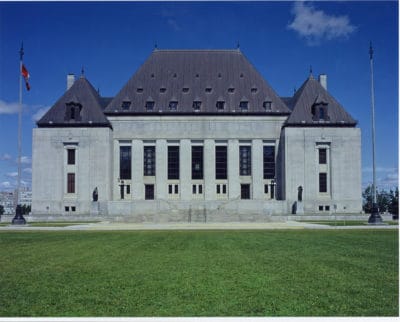
Image Copyright Supreme Court of Canada – Photo Credit Philippe Landreville
In Canada we appoint, as opposed to elect, our judges. This is true at all levels of our court system, though processes vary. Traditionally, judges of the Supreme Court are appointed by the Governor General-in-Council, based on the advice of the Queen’s Privy Council for Canada. This “advice” is generally exclusively garnered through consultation with the Prime Minister. The provinces and parliament have historically had no formal role in the appointment of a judge to the Supreme Court.
However, Prime Minister Trudeau has shaken things up by changing the process by which appointments are made. Instead of being selected, anyone eligible can now apply to the job. An independent and nonpartisan advisory board identifies suitable candidates. The identity of the members of the advisory board, the assessment criteria and process used with applicants is available to the public.
Once the advisory board compiles a shortlist of candidates, parliament gets involved. The Minister of Justice consults the Chief Justice, provincial and territorial attorneys-general, members of the House’s justice and human rights committee, the Senate’s legal and constitutional affairs committee and the Opposition justice critics. Once a nominee is selected, as Justice Martin has been, a special justice and human rights committee hearing is held where the Minister of Justice and the chair of the advisory board will explain the reasons behind the nomination. In the case of Justice Martin, this hearing took place December 4th. Members of the house then have an opportunity to participate in a Q & A session with the nominee, which Justice Martin participated in December 5th.
Justice Malcolm Rowe, from Newfoundland, was appointed under the new process to fill the vacancy left by Justice Thomas Cromwell in October 2016. You can check out his application questionnaire here.
However, it is noteworthy that this new more transparent process is not law so nothing legally compels the Prime Minister to follow it.
Eligibility
In order to be eligible for appointment, or to apply for the top job, candidates must be current judges of the Superior Court system or have been members of the legal bar (lawyers) for at least ten years. They must also be bilingual.
Regional Representation
There are nine seats on the Supreme Court. Three are reserved for judges from Quebec. This is the case despite the fact that only 24% of Canada’s population resides in Quebec, but is considered justified due to Quebec’s very different legal system.
Of the remaining six seats, three are to be filled by judges from Ontario, two from western provinces, divided generally as one from British Columbia and then a rotation between the other provinces and one judge from the Atlantic provinces typically Nova Scotia or New Brunswick. If Justice Martin is appointed there will be two judges from the province of Alberta on the court.
While consideration is given to regional representation, there have been no formal changes to ensure equitable representation with respect to race or gender. Presently all justices of the Supreme Court are white. Four are women and five are men. Critics were generally surprised by Trudeau’s appointment of Justice Rowe, a white man, in 2016 and, as noted, it was expected that he may have appointed an Indigenous judge next.
The Next Chief Justice
While Justice Martin would take Chief Justice McLachlin’s place, she would not replace her as Chief Justice. Yesterday it was announced that the Chief’s shoes will be filled by a Harper appointee, Justice Richard Wagner who is presently 60 years old. Prime Minister Trudeau follows custom with this appointment – Traditionally, the Chief Justice post is filled alternately by the most senior anglophone and francophone member of the court. Justice Wagner is the most senior francophone member of the court.
 The Liberal government has introduced changes to the federal parental leave benefits program. Details of the changes were announced early November and are set to come into force on December 3, 2017. This change is separate from the various Bill 148 changes coming down the pipe.
What’s New?
These are not additional monetary benefits, but rather, once the changes come into effect, eligible parents will be able to spread their 12 months of EI parental leave payments over 18 months. This means that the parent on leave will now be eligible to receive up to $326 a week for 18 months, as opposed to the current 55% of average weekly earnings or a max of $543 a week for 12 months. While the 18 months of leave can be split between two parents, it must be taken all at once. Expectant mothers will also be able to start their maternity leaves 12 weeks before the baby is due.
Who will be affected?
Currently, the changes only affect employees in the federally regulated sector, which includes banking, transportation, telecommunication companies and other federally regulated businesses. We will have to wait and see if the provinces similarly change their legislation to follow suit. So far only Ontario has publicly committed to doing so.
The new 18 month leave will only be available to parents beginning their leave after the changes come into effect on December 3, 2017, and is not available to parents currently on leave.
What will this mean for employers?
Unless an employer offers a “top-up” to an employee’s income during parental leave, they are not required to continue to pay an employee’s salary during a parental leave. Employers will continue to be required to hold the employee’s job open, now for 18 months instead of 12, and to continue to pay for their extended health care benefits during the leave period.
Federally regulated workplaces will need to amend existing parental leave policies to reflect the changes. If employers offer a “top-up” to the EI parents will receive on leave, then employers will need to decide how they will deal with situations where employees opt to take the full 18 months.
Additionally, any reference to lengths of parental leaves in contracts, including Collective Agreements, will need to be updated.
Pregnant Employees
While having an employee take a parental leave can be disruptive to the workplace, employers need to be aware that pregnant employees are protected from discrimination by human rights law. Employers should take care not to make assumptions about what a pregnant woman can or cannot do. Comments, for example, about “mommy brain” are not appropriate. Employers cannot terminate an employee, or unilaterally change her working conditions, because she is pregnant. As with most things in life, good communication is key. If an employee tells you they are expecting, the first words out of your mouth should be congratulations!
Time will tell if employees will take advantage of the new 18 month leave. As the amendments do not affect the amount of money available to parents on parental leave, just length of time, it is anticipated that taking 18 months will not be affordable for many families. However, it is also anticipated that extending the leave period to 18 months will encourage more fathers to take a leave.
Brace yourself, Ontario. Today Bill 148 passed Third Reading and the Ontario Legislature passed the bill into law. Most of the changes will come into force on January 1, 2018, while a small handful of the amended ESA sections may possibly come into force as early as December 3, 2017 (leave of absence related provisions). Provisions related to equal pay come into force on April 1, 2018.
As an aside, it also appears that the high heels OHSA amendment I blogged about this morning was incorporated into the final version of Bill 148 and thus also became law this afternoon. Happy new year to those women who can no longer be forced to wear heels if they don’t wish to.
Stay tuned for details on what this all means. For now, feel free to review our past blog posts on highlights of Bill 148 or go straight to the full text of the Bill on the Legislative Assembly of Ontario’s website.
The following acts are amended by this bill, making this an expansive and important moment in the development of Ontario’s workplace laws:
 Not for much longer… Last month, Ontario Liberal MPP Cristina Martins’ bill to ban mandatory high heels in the workplace sped through the legislature. The bill, titled the Putting Your Best Foot Forward Act, 2017 passed first reading on October 17, 2017, second reading on October 19, 2017, and has been referred to the standing committee. I was recently interviewed for CBC Radio regarding the proposed bill of banning high heels in the workplace.
Proposed Amendments to the OHSA
The Bill would make amendments to the Occupational Health and Safety Act (“OHSA”) to prohibit employers from requiring employees to wear footwear that is not appropriate to the protection required for the employee’s work, or that does not allow the employee to safely perform his or her work.
Specifically, the Bill would amend section 26 of the OHSA by adding the following:
Footwear
26(4) An employer shall not require an employee to wear footwear that,
(a) is not of a design, construction and material appropriate to the protection required for the employee’s work; or
(b) does not allow the employee to safely perform his or her work.
Human Rights and Dress Codes
I think by now we all know that wearing high heels is not good for our bodies. If you had any doubt check out this Huffington Post article for some gruesome details. While it is generally a violation of the Ontario Human Rights Code to require employees to dress differently based on gender, it is no secret that many businesses in the service industry require female employees to wear sexualized outfits. This is discriminatory because they do not require the same of male employees. Check out this CBC news article for more on this.
The Ontario Human Rights Commission advises as follows with respect to gender specific dress codes:
Dress codes that require female employees, and not male employees, to wear heels are thus already likely in violation of human rights law.
What Type of Dress Code is Acceptable?
Dress code policies should be flexible and specific to business needs. They should not differentiate based on sex, gender identity, race, disability, gender expression or religious faith. Employees should be able to choose from this range of options without pressure or coercion. Under the new Bill employers will also not be able to require employees to wear footwear not appropriate to the protection required for the employee’s work, or that does not allow the employee to safely perform his or her work. If the Bill becomes law, which it is expected to, employers currently requiring employees to wear heels, male or female, will need to update their policies.
 Bonus entitlement is always a juicy topic. In September the Ontario Superior Court of Justice released a decision that shed some light on the issue of how entitlement to a bonus will be treated where an employer has no formal bonus policy, but a consistent past practice.
In Fulmer v. Nordstrong Equipment Limited, a wrongful dismissal case, the former employee (“Fulmer”) had received a discretionary bonus in each of his six years with the employer. The employer attempted to argue that their “unofficial” bonus policy was that terminated employees would not be provided with any bonus pro rata or otherwise. In this case there was no employment contract, and the termination letter was silent on both entitlement to a bonus and any performance issues.
The employer argued post-termination that they discovered issues related to Fulmer’s performance, which would have disentitled him to his 2016 bonus, a period during which Fulmer was still actively at work. The judge dismissed this argument, commenting that the employer was simply seeking reasons for which to disentitle the plaintiff from his bonus.
Bonus Entitlement
The judge looked at the employer’s 2016 profitability and awarded Fulmer a $20,000.00 bonus for 2016. While Fulmer argued that he was also entitled to his 2017 bonus during the ten month notice period falling in 2017, the judge determined that because bonuses were calculated at the end of the year, and based on the employee’s positive contributions to the company throughout that year, it was not reasonable to expect a bonus for 2017. Justice Diamon made the following comments, emphasising the plaintiff’s duty to mitigate during the notice period: “I do not find it to be within the reasonable expectation of the plaintiff (charged with a duty to mitigate his losses) to be able to earn a bonus for the 2017 calendar year while he searched for alternative, comparable employment.”
Take Aways
Courts will look to what is fair and reasonable in determining entitlement to bonuses. Simply because a bonus is “discretionary” does not mean that it can be awarded in an unfair or arbitrary way. Courts will look for a bonus process, even in the absence of an official policy.
Where an employer attempts to justify an “unofficial policy” in a way that is not fair, a negative inference is likely to be made as against the employer.
This case serves as a reminder of the importance of the following:
As in this case, courts will look to past practice, and what is fair and reasonable, to determine the quantum of a bonus where there is no official policy.
Something went wrong with the twitter.

In the rapidly evolving landscape of tech, Generative Artificial Intelligence (GenAI) is becoming a central player, especially in sectors like customer service, content creation, and…
In the world of employment law, terminations tend to steal the spotlight. But what about when the employee is the one ending the employment relationship?…
Sign up to our newsletter. Stay up to date with the fast pace of employment law developments and keep your workplace compliant.
Get in Touch!
Contact SpringLaw today for your workplace disputes, compliance and relationship repair issues.


416-238-8180 I info@springlaw.ca

111 Queen Street East, Suite 450, South Building
Toronto, Ontario, M5C 1S2