
Don’t Leave it to Luck: Update Employment Contracts Following Substantial Changes to the Job
 With St. Patrick’s Day having just passed, many of us start to bank on luck at this time of the year. While luck might get you to the end of the rainbow on some things, we wouldn’t recommend that you lean on luck when it comes to non-existent, outdated or incomplete employment contracts.
The Consequences of Leaving it up to Luck
First, in case you’re new here or need a quick refresher, employment contracts are often recommended by lawyers and adopted by employers to bring a level of certainty to the employment relationship. Employment contracts can achieve a variety of things but generally, they set out the responsibilities and expectations of the employee and employer. If the employment relationship is bound by provincial employment standards legislation (it usually is), then the contract has to, at the very least, uphold the minimum standards of the applicable legislation.
If your employment contract runs afoul of the applicable employment standards legislation by failing to uphold the minimum standards as required by the law, your contract could be deemed unenforceable. Contracts could also be found to be unenforceable if they fail to comply with the principles of contract law.
 This past Monday marked the three-year anniversary of the date the World Health Organization declared COVID-19 a pandemic. Since that fateful day in 2020, a lot has changed. Though there remain areas where transmission rates are still high, increased vaccination rates, higher immunity, and public health measures have helped curtail the spread of the virus and significantly decreased the rate of new infections in Canada.
  Our modern, post-pandemic world continues to evolve into a new era of work. As workplaces increasingly move towards remote or at least hybrid environments, companies are sorting out how to build infrastructures that support ongoing culture, performance and customer satisfaction.
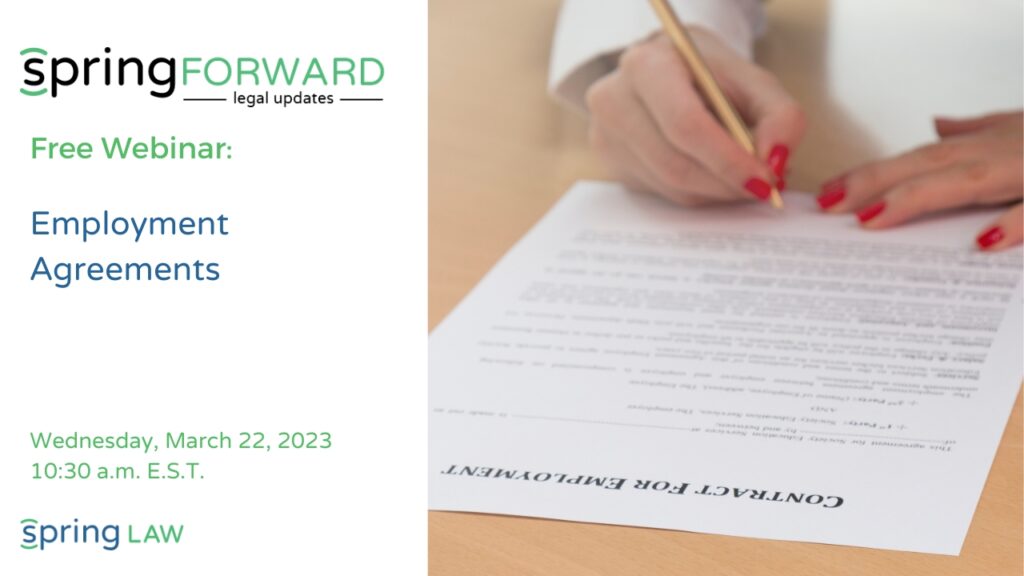 So many of our clients come to us with legal issues that resulted from poorly crafted employment agreements.
 Toronto Mayor John Tory shocked the city last week by announcing his resignation due to an intimate relationship with one of his staff. Whatever your opinions about infidelity or John Tory may be, the scandal is a reminder to employers that workplace relationships may develop outside of professional boundaries. At best, these professional-turned-personal connections lead to a healthy and happy relationship for the employees in question. They put up professional boundaries while at work, you get a wedding invitation in the mail and, bonus, they can now carpool to the office. Not all relationships will not follow such a seamless trajectory, however, and can lead to significant disruption and ethical and legal conundrums for an employer. A
  A new year often means some level of house-cleaning by employers, including the updating of core workplace documents. SpringLaw has seen a spike in this work because many employers understand, now more than ever, the need to have their employment contracts reviewed, with a particular focus on termination provisions. This review should include any ancillary policies, Codes of Conduct, or plan documents referencing when and under what circumstances an immediate termination for cause can occur. We refer to this as a ‘


